I once invited a well-known broadcaster to participate in our Katha Kathan (storytelling) performance. To my surprise, he declined, explaining that he was uncomfortable with stage performances. I found this unexpected because the role did not involve anchoring or public speaking; he was simply required to read a story in a dramatic, expressive manner.
On another occasion, while browsing through a music store, I came across a CD by a renowned Marathi stage actress. Without hesitation, I purchased it, eager to listen to her work at home. However, the experience was deeply disappointing. Her recorded performance lacked even half the brilliance she typically displayed on stage. I began to wonder what was holding her back. It soon became clear to me that many stage performers draw immense energy directly from a live audience. This immediate feedback loop fuels a dynamic performance. Consequently, because they thrive on live crowd responses, they often struggle to find the same inspiration within the sterile, closed-door environment of a recording studio.
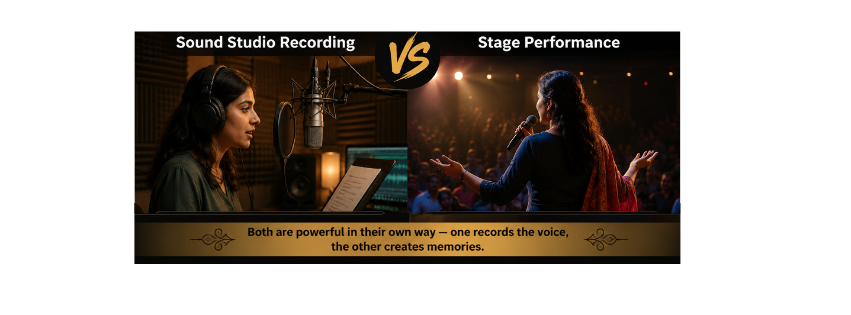
Both stage performance and studio recording are equally challenging, yet they demand entirely different skill sets. Personally, I have always found studio recording to be more manageable. It offers the luxury of retakes, allowing artists to review their recorded tracks, make necessary adjustments, and continuously improve. Furthermore, a studio provides a supportive team of sound engineers and directors to guide the process. Conversely, a stage performer never gets a second chance. Live performance demands absolute confidence, an intuitive understanding of the audience, and complete mastery of the material—ideally supported by a high-quality sound system. In contrast, studio work hinges entirely on acoustics, microphone technique, and an intimate understanding of audio technology.
In the voice-over industry, many artists launch their careers through live anchoring, eventually transitioning into storytelling or poetry recitation. This pathway helps them build local recognition before they branch out into various other forms of voice-over work. However, only a few stage performers possess the creative initiative to conceptualize and develop original programs from scratch; those who do often enjoy enduring success. These versatile individuals rarely enjoy standard studio sessions because their passion extends beyond simple voice work. They are true creators, seamlessly transitioning between the roles of writer, director, and performer.
Ultimately, transitioning from the studio to the live stage is often more challenging than moving from the stage to the studio. Yet, for a truly passionate artist, both mediums serve as equally rewarding playgrounds for self-expression.
Madhavi Ganpule
(Sept 16, 2018)